

Rapid Load Tester
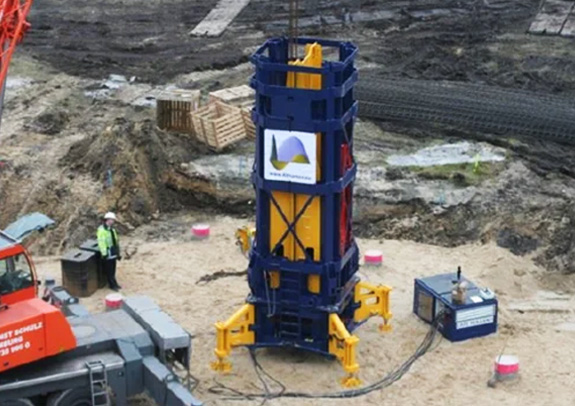
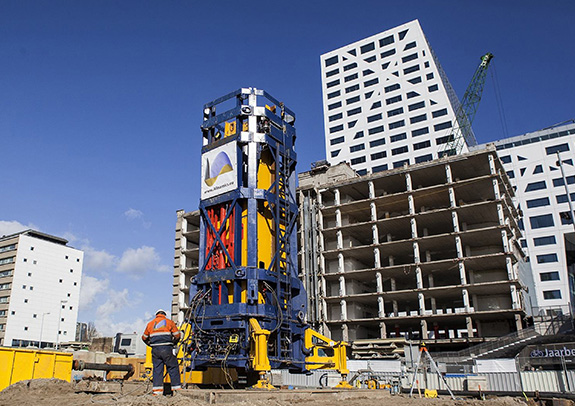
Rapid Load Testing (RLT) is an alternative for Static Load Testing (SLT) of foundation piles. The StatRapid (STR) device has been designed to perform Rapid Load Testing in a safe, reliable and cost effective way. During Rapid Load Testing the load duration is such that pile and soil behaviour are quasi static.
A StatRapid device consists of a lifting and guidance frame, a modular drop mass, a catch mechanism and a modular soft spring system. The size and duration of the load can be adjusted by varying the drop mass weight, the spring stiffness and the lifting height. The system is hydraulically operated and has sensors for a proper vertical and stable position. It should be noted that the dead weight of the drop mass can also be used for the first (static) loading cycle. StatRapid devices are manufactured by Cape-Holland
The catch mechanism catches the drop mass after bouncing up from the springs. This prevents unwanted rebounds and
allows for successive cyclic testing with increasing loads similar to static load cycling testing. In accordance with the
CUR and ASTM standards the load, displacement and acceleration are measured near the pile top [D] and then
recorded. The load is measured with load cells(s)[A], the displacement with an optical system (Reyca) [B] and the
acceleration with a servo accelerometer[C]. The load cells are placed on a load transfer steel plate (E)
The required load duration for Rapid Load Testing depends on the pile length. The modular set up allows for the tuning
of the StatRapid system for piles with different lengths before going to site. With the AllWave-RLT simulation
program the set-up can be checked to satisfy the RLT condition.
Features
- Site assembling using a crane.
- Hydraulic power unit and generator.
- Modular and adjustable rubber spring system.
- Monitoring and reporting software (Allnamics-RLT).
- Swing frame for extra precise handling and lifting of the top frame.
- Internal hydraulic lifting system for adjustable drop height up to 4m.
- Test data analysis based on user-independent principles (CUR-230).
- Mechanism for catching the drop mass after rebounding from the springs.
- Electronic control of the frame inclination by joystick and hydraulic presses.
- Modular drop mass so the mass can be adjusted to achieve the required load.
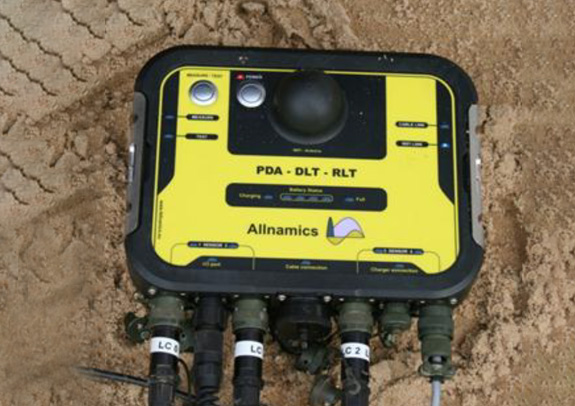
- Data Acquisition System (Allnamics-PDR) with optional Wi-Fi data transmission.
- For a simple calibration three (smaller) load cells are used instead of one large load cell.
- Instruments consist of load cells, a servo-accelerometer (s) and an optical measuring system.
- Prediction software (AllWave-RLT) to determine the required spring stiffness, drop mass and drop height.
- System designed for safe and reliable operation. The StatRapid frame consists of a bottom frame and a top frame.
- Test data analysis in accordance with the Dutch CUR recommendations, taking into account loading rate dependencies of the soil.
- Measurement and test procedure in accordance with ASTM D7383-10, and the latest draft for the Euro code (EN_ISO_-22477-X_ (e)).
- Multi-cycle test, with several loading cycles. The first load cycle is performed with the static weight of the drop mass on the pile head. The next loading cycle is applied with a small drop height to minimize the loading rate and damping effects with the pile stiffness very close to the stiffness during a static load test. Afterwards the load is gradually increased to determine the load bearing capacity of the pile.